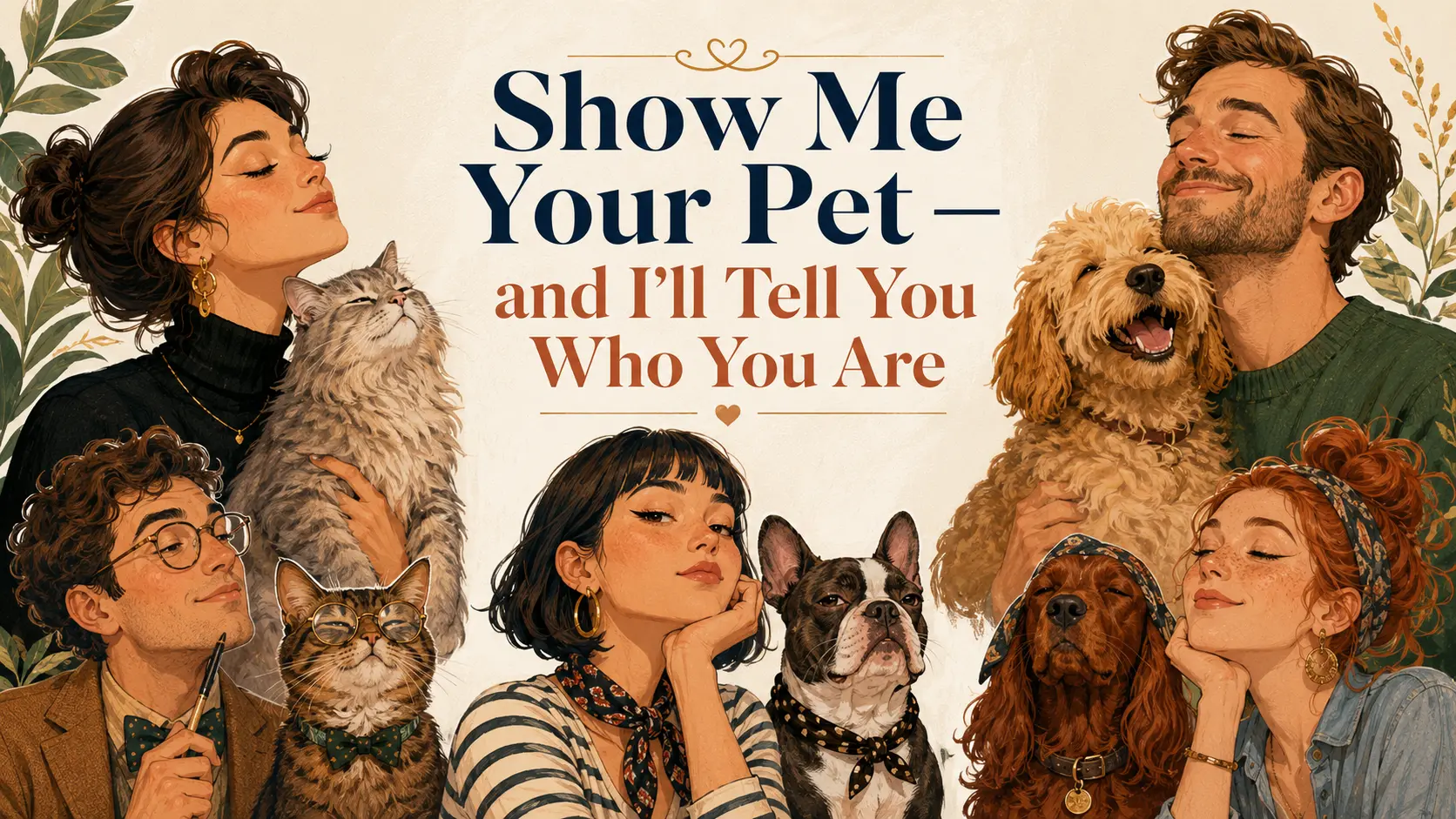
Show Me Your Pet — and I’ll Tell You Who You Are
Have you ever noticed a serious-looking man walking an equally serious bulldog? Or a woman with wild curls carrying a tiny dog whose coat seems to have exactly the same energy?
People often joke that pets look like their owners. Sometimes the resemblance is physical: similar hair, expressions, posture, or even the same slightly judgmental stare. In other cases, the connection is less visible. An energetic owner has a dog that never stops moving. A quiet homebody shares the sofa with a cat that considers leaving the house completely unnecessary.
But is this resemblance real—or do we simply notice the funniest examples?
Research suggests that the connection between people and their pets may be more than coincidence. We may choose animals that feel familiar to us, shape their routines through the way we live, and gradually influence one another’s emotions and behavior.
So, what might your pet reveal about you?
Do Pets Really Look Like Their Owners?
The idea sounds like a comedy sketch, but researchers have tested it.
In one study, participants were shown photographs of dog owners and asked to identify their dogs. They were able to match some owners and purebred dogs more accurately than chance would predict. Interestingly, the length of time the owner and dog had lived together did not explain the resemblance.
That supports an intriguing possibility: people may not necessarily grow to look like their dogs. They may choose dogs that already seem familiar to them.
Another experiment found that the eye area played an important role in people’s ability to match dogs with their owners. When the eyes were hidden, identifying the correct pairs became much more difficult.
Apparently, the resemblance may not be about matching hairstyles or body size. Sometimes it is simply the look in their eyes.
Of course, this does not mean that every tall person secretly wants a Great Dane or that everyone with curly hair will come home with a poodle. The effect is subtle, and appearance is only one part of choosing a companion.
Still, humans are naturally drawn to what feels recognizable. We often prefer familiar faces, personalities, environments, and styles. It would not be surprising if the same instinct influenced our choice of pets.
We Often Choose a Pet That Fits Our Identity
Choosing an animal is rarely a completely neutral decision.
A person who imagines long weekend hikes may be attracted to an athletic dog. Someone who values quiet evenings may prefer an independent adult cat. A highly social household may want a friendly pet that enjoys visitors, while a person living alone may look for a close and affectionate companion.
Even when people say, “I just knew this was my pet,” that immediate connection may be based on dozens of subconscious signals:
- the animal’s expression;
- energy level;
- body language;
- size and appearance;
- confidence or shyness;
- the lifestyle we imagine having together.
Sometimes we choose an animal that resembles who we already are. At other times, we choose one that represents who we would like to become.
A sedentary person may adopt an active dog because they want motivation to spend more time outdoors. A busy, anxious person may be attracted to a calm cat because the animal represents the peace missing from everyday life.
Your pet, therefore, may be either your reflection—or your counterbalance.
Your Dog May Reflect Your Social Energy
Dogs make their owners’ lifestyles especially visible because their needs become part of the daily schedule.
A highly active dog usually requires walks, outdoor stimulation, play, training, and regular interaction. Living successfully with that dog often demands consistency and a willingness to organize part of the day around another creature.
That does not automatically mean every energetic dog owner is athletic and disciplined. Sometimes it means the owner is learning to become more structured because the dog leaves no alternative.
People who include their dogs in hikes, day trips, and outdoor adventures often see them as partners rather than animals that remain at home. Practical items such as dog backpacks or portable supplies become useful because they support an existing shared lifestyle—not because owning the equipment proves anything about a person’s character.
A relaxed companion dog may suit an owner who prefers slower walks and quiet routines. A confident, sociable dog may thrive in a home filled with guests. A sensitive rescue may form a particularly strong bond with someone who notices small emotional signals and values trust that develops gradually.
The match is not always perfect from the beginning. Much of the resemblance develops because two lives become closely connected.
Your Training Style Says More Than the Breed
How you communicate with your dog may reveal more about you than the type of dog you own.
Some people enjoy clear schedules, repeated exercises, and predictable rules. Others are more spontaneous and flexible. Some naturally reward progress, while others become frustrated when results are not immediate.
Dogs respond to these differences.
A patient owner may create an environment in which a cautious dog becomes more confident. An inconsistent household may unintentionally produce confusion, even in a naturally calm animal. An anxious owner may watch every movement and interpret ordinary behavior as a potential problem.
This does not mean owners are responsible for every aspect of a dog’s personality. Genetics, early development, health, previous experiences, and socialization all matter. However, daily interaction can strengthen or soften particular behaviors.
Owners who enjoy solving problems with their dogs may use training games and interactive dog toys to provide mental stimulation. In this context, the product is not a shortcut to good behavior. It is simply one tool that supports communication, curiosity, and shared activity.
Owners and Dogs Can Share Personality Traits
Research involving dog–owner pairs has found associations between human personality and the personality owners report in their dogs.
For example, more extroverted owners may describe their dogs as more active and excitable, while owners with different personality traits may notice corresponding differences in fearfulness, responsiveness, or aggression. A large study examining dog personality across age groups also found connections between owner and dog characteristics.
There are several possible explanations.
First, people may select dogs whose personalities suit them. Second, owners create the environment in which the dog lives. Third, owners and dogs influence each other over time. Finally, some similarity may come from perception: we may interpret our pets through the lens of our own personality.
The safest conclusion is not that dogs become psychological copies of their owners. Rather, compatible personalities, shared routines, mutual adaptation, and human interpretation all contribute to the resemblance.
Your Pet May Absorb the Emotional Climate at Home
The connection can go beyond visible behavior.
A study measuring cortisol in hair found that long-term stress levels in dogs and their owners could become synchronized. The researchers did not conclude that dogs simply “copy” every human emotion, but the results suggest that dogs living closely with people can reflect aspects of their owners’ long-term emotional state.
Dogs watch us constantly. They notice changes in voice, posture, breathing, movement, routine, and attention. They often know that something is wrong before another person does.
A tense household may make a sensitive dog more vigilant. A predictable environment may help the same dog relax. Calm interaction, regular exercise, mental stimulation, and a safe place to rest can all influence how the dog experiences everyday life.
This relationship works in both directions. A dog can also change the owner’s routine, encourage physical activity, create social contact, and offer a comforting sense of stability.
You are not simply shaping your dog. Your dog is shaping you too.
What Does Your Cat Say About You?
Cats are often described as low-maintenance pets for independent people, but that stereotype is too simple.
Cats need social interaction, play, environmental enrichment, healthcare, and routines suited to their individual temperament. They may express attachment more subtly than many dogs, which means their owners often become skilled at reading small changes in posture, movement, appetite, and behavior.
A study involving more than 3,000 cat owners found relationships between owner personality and reported aspects of cat behavior, health, and management. However, the researchers also emphasized that these associations do not prove a simple cause-and-effect relationship.
The owner may influence the cat. The cat may affect the owner. Certain owners may select particular cats. Personality may also influence how people interpret and report their animal’s behavior.
What a cat reveals most clearly is often not whether the owner is introverted or extroverted, but how that person handles boundaries.
Cats rarely respond well to forced affection. They tend to reward observation, patience, and respect for choice. A strong relationship with a cat often develops when the owner understands when to approach—and when to leave the cat alone.
The Way You Entertain Your Cat Reveals Your Attention
A cat that sleeps for most of the afternoon is not necessarily bored. Rest is normal feline behavior. But a cat also needs opportunities to climb, watch, stalk, chase, scratch, and explore.
Owners who observe which activities their cats genuinely enjoy tend to build a more individualized environment. One cat may love chasing moving objects, another may prefer food puzzles, and another may spend hours monitoring the street from an elevated position.
Instead of buying random accessories, attentive owners select things that support natural behavior. Interactive cat toys can encourage stalking and chasing, while cat window perches give visually curious cats a safe place to observe the outside world.
The important part is not the number of products in the house. It is whether the environment reflects the cat’s actual personality.
Do Pets Become More Like Us Over Time?
Physical resemblance is probably influenced more by initial selection than by years spent together. Your dog is unlikely to develop your nose after sharing the sofa for a decade.
Behavioral resemblance is different.
Pets adapt to household schedules. They learn when the home becomes active, when food appears, when people rest, and what kinds of behavior attract attention. Owners also adjust their habits to accommodate the animal.
Over time, this creates a shared rhythm.
An early riser may have a dog waiting at the door before sunrise. A late-working owner may have a cat that becomes playful around midnight. A calm household may produce predictable daily patterns, while a constantly changing schedule may require the pet to remain more adaptable.
Owners and pets can even develop recognizable shared rituals: a particular morning walk, brushing before bed, sitting together during work, or playing at the same time each evening.
Regular grooming is one example. For some dogs, brushing is merely coat maintenance. For others, it becomes a quiet bonding routine. The right dog brush may make the process easier, but the meaningful part is the repeated calm contact between owner and animal.
What Your Pet Cannot Tell Us About You
It is tempting to turn pet ownership into a personality test:
“Large dog means confident owner.”
“Cat means introvert.”
“Rescue animal means highly empathetic person.”
Reality is more complicated.
People choose pets because of housing restrictions, family needs, allergies, availability, finances, previous experience, or simply an unexpected emotional connection. A person may adopt the only animal left at a shelter and discover a perfect relationship that no personality quiz could have predicted.
Breed stereotypes can also be misleading. Individual differences within a breed may be substantial, and upbringing, health, socialization, and environment all influence behavior.
Your pet may offer clues about your priorities, habits, and emotional world, but it cannot provide a complete psychological diagnosis.
A Quick Pet–Owner Mirror Test
Think about your life together and ask:
Do you share the same energy level?
Are you both ready for activity—or equally delighted by a quiet afternoon?
Do you react to stress similarly?
Do both of you become restless, withdrawn, vocal, or unusually attached?
Did you choose your pet for familiarity or contrast?
Does the animal resemble you, or possess qualities you wish you had?
Has your routine changed because of your pet?
Are you now more active, patient, organized, social, or observant?
Do you respect your pet’s real personality?
Or are you expecting the animal to fit the personality you imagined?
The answers may reveal more than the species, breed, or coat color ever could.
Choosing Products for the Pet You Actually Have
The most thoughtful pet owners do not simply collect accessories. They choose equipment that solves a real problem or supports behavior the animal already enjoys.
A small dog that becomes overwhelmed in crowded places may benefit from a secure dog carrier. A cat that ignores a stationary bowl but enjoys moving water may drink more readily from one of the available cat water fountains.
These choices do not define your personality. But they can show that you are paying attention.
The goal is not to force your pet into your lifestyle. It is to create a shared life that works for both of you.
Final Verdict: Is Your Pet Your Mirror?
Sometimes, yes—but not in the simplistic way social media makes it seem.
You may have chosen a pet whose appearance or personality felt familiar. Your routines may have shaped the animal’s behavior. Your emotional states may influence each other, and years of shared experiences may create similar habits and reactions.
At the same time, your pet remains an individual, with a temperament, history, preferences, and needs that cannot be reduced to a reflection of you.
Perhaps that is the real reason the resemblance feels so fascinating.
Your pet is not exactly like you. But the life you build together leaves visible traces on both of you.
So, show me your pet—and I may not be able to tell you exactly who you are.
But I will probably learn something about what you value, how you live, and whom you choose to love.
